Tooth Decay Explained: When Do You Need a Filling or Root Canal?
8 October 2026
By Dr Goran Prokic | Principal Dentist | MGA Dental
Tooth decay is one of the most common dental problems, but not every cavity needs the same treatment.
As a dentist, one of the most important things I explain to patients is that the treatment depends on how far the decay has progressed through the tooth.
A small area of early decay affecting only the outer enamel may sometimes be stopped or remineralised with the right care. Once decay moves through the enamel and into the softer dentine underneath, a filling is usually needed. If it reaches the dental pulp, where the tooth’s nerve and blood supply are found, treatment can become more complex and may involve root canal treatment or extraction.
This is why two teeth that both appear to have a cavity can require very different treatment.
One patient may need a straightforward filling. Another may have decay very close to the nerve and need a deep filling with additional protection. If bacteria have already infected the pulp, a simple filling may no longer be enough.
Tooth decay often causes few or no symptoms in its early stages. Cavities between the teeth can also be difficult to see without dental X-rays, which is why regular dental examinations and appropriate bitewing X-rays are important for detecting decay before it becomes deeper and harder to treat.
Understanding what happens as decay moves through a tooth helps explain why treating a cavity early can make such a significant difference.
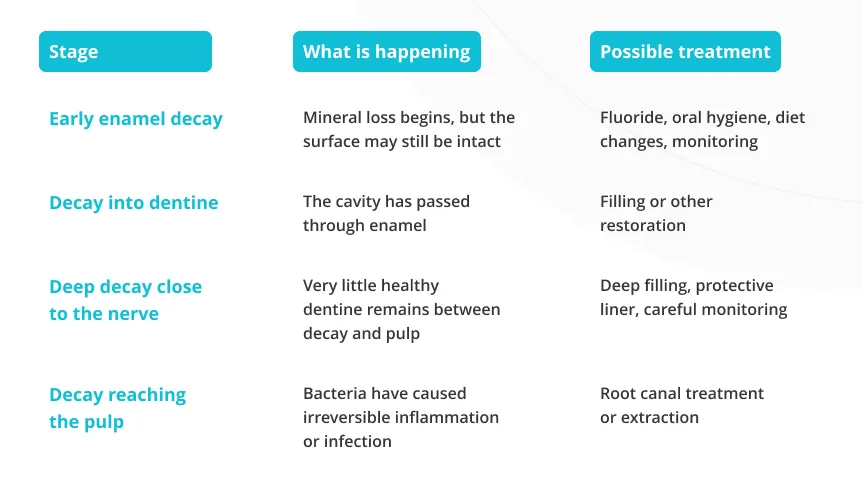
Quick Guide:The Stages of Tooth Decay
The treatment required for tooth decay depends largely on how far it has progressed.
The important message is simple: the earlier tooth decay is identified, the more healthy tooth structure we generally have available to preserve.
What Actually Is Tooth Decay?
Tooth decay, also called dental caries, is a disease process where acids produced by bacteria gradually weaken and damage the tooth structure.
Our mouths naturally contain many types of bacteria. When sugars and other fermentable carbohydrates are consumed, bacteria in dental plaque use them and produce acids. These acids attack the tooth surface and cause minerals to leave the enamel.
The tooth is constantly going through periods of mineral loss and repair. Saliva helps neutralise acids, while fluoride and minerals such as calcium and phosphate support remineralisation.
Problems develop when mineral loss happens too often and the tooth does not have enough time to repair itself. Over time, the enamel weakens and a physical cavity can form. From there, bacteria and decay can move into the deeper layers of the tooth.
Understanding the Layers of a Tooth
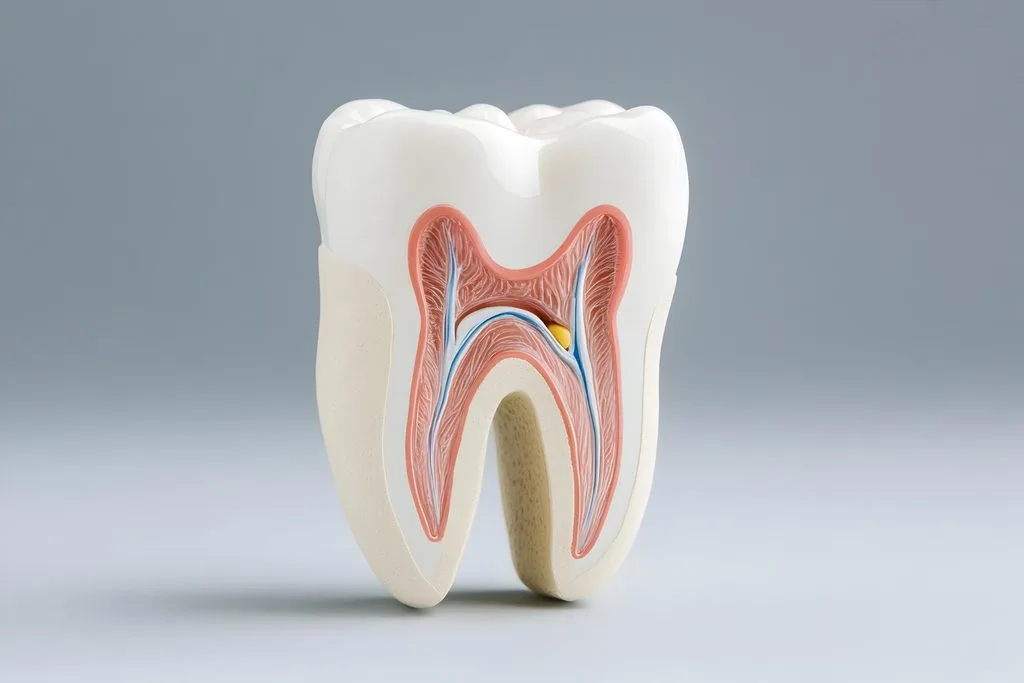
To understand why the depth of decay matters, it helps to understand the basic structure of a tooth. The deeper decay travels through these layers, the more complex treatment usually becomes.
Enamel
Enamel is the hard outer covering of the tooth crown. It is highly mineralised and protects the softer structures underneath.
Importantly, enamel does not contain nerves. This is one reason early decay can progress without causing pain.
Dentine
Underneath the enamel is dentine. Dentine is softer than enamel and contains microscopic tubules that communicate with the inner portion of the tooth.
Once decay reaches dentine, it can generally progress more quickly than it did through enamel. Patients may begin to notice sensitivity to cold, sweet foods or other triggers, although some patients still have no symptoms.
The Dental Pulp
At the centre of the tooth is the pulp chamber. The dental pulp contains nerves, blood vessels and connective tissue. It continues from the crown of the tooth through small canals within the roots. This is the tissue patients often refer to as “the nerve.”
When decay is still separated from the pulp by healthy dentine, there may be an opportunity to remove the decay and restore the tooth with a filling. When bacteria reach the pulp and cause irreversible inflammation or infection, the situation changes considerably.
At that stage, root canal treatment or extraction may become necessary.
Can Early Tooth Decay Be Reversed?
In its earliest stages, yes, under the right circumstances.
Before a physical cavity has developed, enamel can begin losing minerals. Dentists may see this as an early white or chalky area, or identify early changes on appropriate dental X-rays.
At this stage, the tooth surface may still be intact. Because there is not yet necessarily a physical hole that needs to be restored, treatment can focus on changing the conditions that allowed the decay process to develop.
This may involve:
Improved brushing with fluoride toothpaste
Cleaning between the teeth every day
Professional fluoride treatment where appropriate
Reducing the frequency of sugary foods and drinks
Improving saliva protection where dry mouth is contributing
Regular monitoring by the dentist
The aim is to shift the balance away from continued mineral loss and towards remineralisation.
This is one of the reasons finding decay early is so valuable. Treatment does not always mean immediately drilling a tooth.
However, once the enamel surface has physically broken down and a cavity has formed, remineralisation alone may no longer be enough. Once decay progresses through enamel and reaches dentine, restorative treatment is generally required.
The dentist removes the diseased tooth structure while preserving as much healthy tooth as reasonably possible. The resulting cavity is then restored using an appropriate filling material, such as a white tooth filling where suitable.
A smaller cavity is usually simpler to treat, which is why early diagnosis can help preserve more natural tooth structure.
Deep Decay: When the Cavity Is Close to the Nerve
Sometimes a cavity is very deep but has not yet caused irreversible inflammation or infection inside the tooth.
When the dentist removes the decay, there may only be a thin layer of dentine separating the cavity from the dental pulp. In this situation, the aim is to remove the disease, protect the pulp where possible, and restore the tooth with a strong, well-sealed restoration.
Depending on the clinical situation, a protective dental material or liner may be placed in the deepest area before the final filling. When successful, the pulp remains healthy and the tooth can continue functioning normally.
However, a tooth with a very deep cavity has a different prognosis from a tooth that needs only a small, shallow filling. The closer decay has progressed towards the pulp, the greater the chance that the nerve has already been irritated or affected.
Why Can a Deep Filling Be Sensitive Afterwards?
Patients are sometimes surprised when a tooth becomes sensitive after a filling, especially if it did not hurt beforehand.
This does not automatically mean something has gone wrong. If the original cavity was very deep, the pulp may already have been irritated by the decay. Cleaning the tooth and placing a restoration can temporarily add further stress to an already sensitive tooth.
Patients may notice sensitivity to cold drinks, cold air, sweet foods, biting or chewing, or temperature changes.
Mild sensitivity may gradually settle as the tooth recovers. However, severe spontaneous pain, prolonged pain after hot or cold, pain that wakes you at night, swelling, or symptoms that continue to worsen should be reassessed.
If you experience these symptoms or are concerned about tooth pain after a filling, contact your dentist for advice. They may indicate that the pulp is not recovering normally and needs further assessment.
Can a Deeply Filled Tooth Need a Root Canal Years Later?
Yes. A tooth with previous deep decay may settle after treatment and remain comfortable for a long time, but the pulp can sometimes deteriorate months or even years later.
This may happen when the original decay was very close to the nerve and the pulp had already sustained significant irritation or injury.
The patient may eventually develop:
Spontaneous toothache
Prolonged sensitivity
Pain when biting
Night-time pain
Swelling
A dental abscess
If the pulp becomes irreversibly inflamed or infected, root canal treatment may be required to retain the tooth. If the tooth cannot be predictably restored, or the patient chooses not to proceed with root canal treatment, tooth extraction may be another option.
This does not necessarily mean the original filling failed. Sometimes it reflects how advanced the decay was before treatment began.
What Happens When Decay Reaches the Nerve?
If decay continues progressing, bacteria can eventually reach the dental pulp, where the tooth’s nerve and blood supply are found.
At first, the pulp may become inflamed. In some cases, this inflammation can still recover, but once it becomes irreversible, placing a filling over the tooth will not solve the problem.
In some cases, the pain may temporarily reduce if the pulp loses vitality. This can make patients think the problem has been resolved, even though bacteria may continue spreading through the root canal system and cause infection around the root.
At this stage, treatment usually involves root canal treatment to retain the tooth or extraction if the tooth cannot be predictably saved.
In some cases, a tooth may also need additional protection after root canal treatment, such as a dental crown, depending on how much natural tooth structure remains.
Why Cavities Between the Teeth Are Easy to Miss
Some of the most important decay occurs in places patients cannot see.
Interproximal decay develops on the surfaces where neighbouring teeth contact each other. A toothbrush cleans the outer, inner and biting surfaces reasonably well, but toothbrush bristles cannot effectively clean the tight contact area between two teeth.
This is why interdental cleaning, including flossing where appropriate, is important.
The difficulty is that interproximal cavities can develop without creating an obvious visible hole. From above, the tooth may look completely normal. A patient may have no pain. Even during a clinical examination, early decay between tightly contacting teeth can be difficult to detect visually.
This is where bitewing X-rays become particularly useful.
Why Bitewing X-Rays Matter
Bitewing X-rays allow the dentist to assess areas between the back teeth that cannot always be adequately seen during a routine examination.
They can help identify interproximal decay and provide information about how far the lesion appears to have progressed. This can allow a dentist to identify decay while it is still relatively small, rather than waiting until a tooth develops pain or a large visible cavity.
The frequency of dental X-rays should be based on the individual patient’s risk and clinical circumstances rather than simply taking them unnecessarily. Patients with a history of frequent decay may require different monitoring from someone who has remained stable for many years.
The important point is that a visual dental examination and an X-ray provide different information. A tooth can look normal in the mouth while an X-ray reveals decay developing between the teeth.
Why Doesn’t Tooth Decay Always Hurt?
One of the biggest misconceptions about dental decay is: “If it doesn’t hurt, it can’t be bad.”
Unfortunately, that is not reliable.
Early decay is often completely painless because enamel does not contain nerves. Even after decay enters dentine, some patients experience little or no discomfort.
Pain often becomes more noticeable as decay approaches or affects the pulp. By the time a tooth develops severe spontaneous pain, the treatment required may be considerably more extensive than it would have been when the cavity first developed.
Waiting for pain before seeing a dentist can allow some cavities to progress much further than necessary. This is why regular preventive dental check-ups are important, even when your teeth feel fine.
What Increases the Risk of Tooth Decay?
Decay is influenced by several factors rather than sugar alone.
Dry mouth caused by some medications or medical conditions
Reflux or frequent vomiting
Previous history of frequent cavities
Difficult-to-clean tooth anatomy
Certain existing dental restorations
Dietary and lifestyle factors
Frequency is particularly important. Repeatedly exposing the teeth to fermentable carbohydrates throughout the day creates repeated periods of acid production.
Good decay prevention therefore involves both effective oral hygiene and sensible dietary habits.
How Can Tooth Decay Be Prevented?
The best treatment for tooth decay is preventing it from progressing to the point where restorative treatment becomes necessary.
Using additional fluoride products when recommended by your dentist
Treating early disease before it progresses deeper
Regular dental care is particularly important because early decay may not produce symptoms.
Tooth Decay Treatment at MGA Dental
Tooth decay is progressive, so the right treatment depends on how far it has progressed.
Early enamel changes may sometimes be managed with preventive care, while deeper decay may require a filling, a protective restoration, root canal treatment, or removal of the tooth if it cannot be saved.
At MGA Dental, our team assesses and treats tooth decay at every stage. A dental examination and appropriate X-rays help us understand how deep the decay is and recommend the most suitable treatment.
Our goal is to find decay early, protect as much healthy natural tooth structure as possible, and help you avoid more complex treatment where possible.
If you are concerned about tooth decay, a cavity, tooth sensitivity, or pain when biting, contact MGA Dental to arrange an appointment.
FAQs About Tooth Decay
1. Can tooth decay heal without a filling?
Very early decay may sometimes be arrested or remineralised if the enamel surface is still intact. Once a physical cavity has formed or decay has reached dentine, a filling or other restoration is usually needed.
2. Why did my dentist find a cavity when I had no pain?
Tooth decay often causes no symptoms in its early stages. Pain is not a reliable way to know whether a cavity is present or how deep it has become.
3. How do I know if tooth decay has reached the nerve?
Possible signs include severe toothache, spontaneous pain, prolonged sensitivity to hot or cold, pain that wakes you at night, swelling, or pain when biting. However, only a dental examination and appropriate imaging can confirm how far the decay has progressed.
4. If a filling is close to the nerve, will I definitely need root canal treatment?
No. Many deeply restored teeth remain healthy. However, the closer the decay was to the pulp, the higher the chance that the tooth may need root canal treatment later.
5. Why do I need bitewing X-rays if the dentist has already looked at my teeth?
Some cavities develop between neighbouring teeth and can be difficult to see during a visual examination. Bitewing X-rays help dentists assess these areas and detect decay that may not be visible in the mouth.
Retainers play an important role in maintaining the results of your orthodontic treatment. Once your teeth are aligned, a retainer helps keep them in place and prevents them from gradually shifting back. However, wearing a retainer also means you need to take proper care of it. Without regular cleaning, retainers can collect bacteria, plaque, and […]
Noticing that your tongue has changed its color can be a stressful experience if you don’t know what is the cause of the discoloration. Changes in the color of your tongue can be subtle or dramatic, depending on the underlying health issue. In this article, we’ll outline the most common types of tongue discoloration to […]
Recovering from a tooth extraction does not end when the procedure is over. What you eat in the days that follow plays a major role in how quickly and comfortably your mouth heals. Choosing the wrong foods too soon can irritate the extraction site, dislodge the protective blood clot, and increase the risk of pain, […]
Maintaining good oral hygiene means brushing your teeth twice a day and flossing regularly. But if you’re diligent about your dental care, you may have wondered: is it possible to brush too much? According to dental experts, the answer is yes. Overbrushing can actually cause damage to your teeth and gums over time. If you […]
A brighter smile is one of the most common cosmetic dental goals, and professional teeth whitening remains one of the fastest ways to improve the appearance of stained or discoloured teeth. Among the available options, laser teeth whitening has become increasingly popular because of its speed and noticeable results. However, many patients still wonder whether […]
If you are missing one or more teeth, you may already be exploring options to restore your smile and chewing function. Dental bridges are a common solution, but a traditional bridge is not always suitable for every situation. When neighbouring teeth are not strong enough to provide support on both sides, a cantilever dental bridge […]
Multiple Sclerosis (MS) may not seem directly related to dental health at first glance, but the connection is stronger than many realise. This chronic neurological condition can affect a person’s ability to maintain proper oral hygiene, leading to an increased risk of dental problems and complications during treatments such as tooth extractions. Understanding how Multiple […]
Osteoporosis is usually thought of as a condition that affects the hips, spine, or wrists. Dental health is not often part of the conversation. However, osteoporosis can have a real and sometimes overlooked impact on your oral health. Bones throughout the body are affected by osteoporosis, including the jawbone that supports your teeth. When bone […]
When a tooth is damaged or weakened, your dentist may recommend a dental onlay or a crown to restore its strength and appearance. While both options protect and rebuild teeth, they differ in how much of the tooth they cover and how they’re applied. In this article, we’ll explain the key differences between onlays and […]